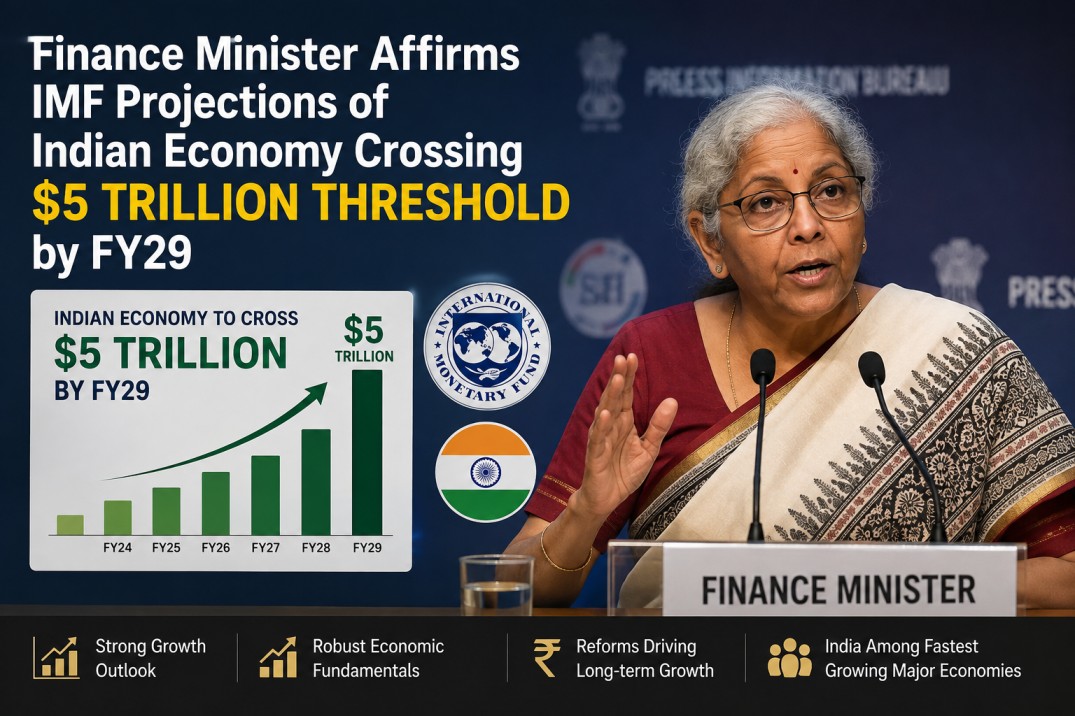
Union Finance Minister Nirmala Sitharaman informed the Rajya Sabha that the Indian economy is firmly on track to cross the $5-trillion Gross Domestic Product (GDP) mark by the fiscal year 2028-29 (FY29), citing projections from the International Monetary Fund’s World Economic Outlook database. In a formal written response, the Finance Minister detailed that India’s GDP at current prices is projected to reach approximately $5.1 trillion by FY29, driven by sustained macroeconomic stability, structural economic reforms, and strategic public investment in infrastructure. Despite global supply chain disruptions and volatile energy prices caused by ongoing international conflicts, the government emphasized that India remains among the fastest-growing major economies globally, with projected growth hovering around 6.6 per cent. The Ministry of Finance highlighted that a broad-based growth strategy—focusing on expanding domestic manufacturing capacity, bolstering digital public infrastructure, boosting service exports, and simplifying business regulations—serves as the core engine for achieving this milestone. International financial institutions, including the World Bank and IMF, have commended India’s healthy financial sector, substantial foreign exchange reserves, low inflation environment, and resilient domestic demand, which provide significant buffers against external shocks. Furthermore, record tax collections under the Goods and Services Tax (GST) regime, combined with rising e-way bill generation and strong capital expenditure deployment by the central government, indicate sustained momentum across goods movement and commercial activity. Economists note that achieving the $5-trillion target will require continued private sector capital investment, rapid growth in high-value technological services, and expanded job creation across manufacturing and agribusiness sectors. The government reaffirmed its commitment to maintaining fiscal prudence while prioritizing capital expenditure in critical economic sectors such as clean energy, transportation networks, urban development, and semiconductor manufacturing. Financial experts view the milestone as a key economic milestone on India’s broader path toward becoming a fully developed economy (‘Viksit Bharat’) by 2047.
Finance Minister Affirms IMF Projections of Indian Economy Crossing $5 Trillion Threshold by FY29