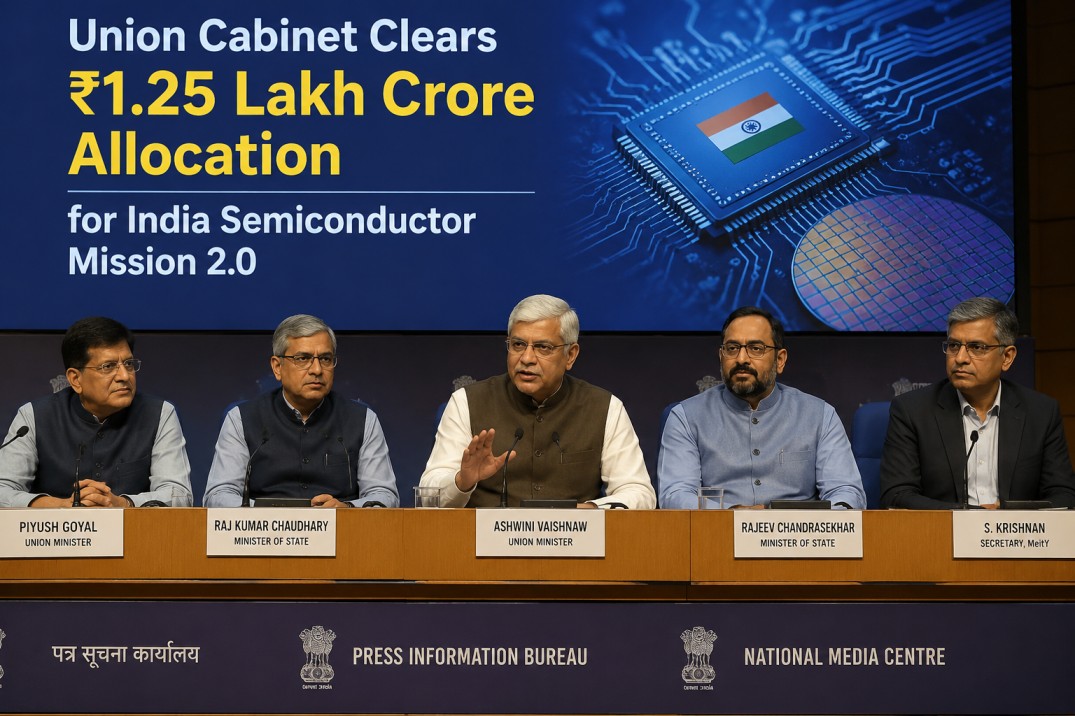
The Expenditure Finance Committee cleared a major funding proposal of ₹1.25 lakh crore for the second phase of the India Semiconductor Mission (ISM 2.0). Initially outlined during the Union Budget, this substantial capital infusion aims to expand India’s domestic chip manufacturing ecosystem, moving beyond basic assembly and testing to advanced wafer fabrication, indigenous design capabilities, specialized equipment manufacturing, and high-purity material processing. Under ISM 2.0, the government plans to offer attractive fiscal incentives, infrastructure support, and long-term capital subsidies to both global technology conglomerates and domestic semiconductor pioneers seeking to set up commercial fabrication facilities across key industrial clusters. Industry leaders have warmly welcomed the multi-year funding allocation, pointing out that establishing localized semiconductor manufacturing is critical to reducing import dependencies across automotive, consumer electronics, telecommunications, and defense equipment supply chains. Furthermore, the initiative seeks to establish dedicated research and development centers in partnership with leading academic institutes to train skilled design engineers and fab technicians, ensuring a sustainable talent pipeline for the industry. The Ministry of Electronics and Information Technology highlighted that Phase 1 succeeded in attracting multi-billion-dollar investments for testing and packaging units, while Phase 2 shifts focus toward high-density chip production and compound semiconductors. Global tech analysts observe that India’s strategic push into semiconductor manufacturing places it among a select group of nations actively restructuring global microchip supply chains to mitigate geopolitical risks. The government expects the funding program to spur substantial private sector co-investments, generating thousands of high-skilled engineering jobs and giving a major fillip to the national ‘Make in India’ and ‘Viksit Bharat’ economic visions. In addition, localized chip design hubs are being set up to encourage deep-tech startups to patent indigenous microprocessors tailored for smart mobility, artificial intelligence, and edge computing platforms. State governments have already begun preparing specialized industrial parks equipped with high-capacity power, uninterrupted water supplies, and logistics linkages to host incoming fabrication plants. The comprehensive blueprint reflects India’s long-term strategy to transform from a major chip consumer into a globally competitive semiconductor manufacturing hub over the coming decade.
Union Cabinet Clears ₹1.25 Lakh Crore Allocation for India Semiconductor Mission 2.0